
The most stressful money in the office


Somebody hands over $62,500 at exchange, and from that moment until settlement it is not your money. It sits in a trust account with rules bolted to it. When it has to be banked. What the receipt has to say. Who can be paid out of it and when. And the one that ends careers, how fast you have to prove each month that the bank and your books are telling the same story.
Most offices we talk to run this on a spreadsheet, a receipt book and the bank's website in another tab. That holds up fine for a while. Then a cheque gets written on a Friday and banked on the Tuesday, or February never gets reconciled and nobody notices until the auditor does, or someone pays out a deposit that has not cleared and the whole office has a very bad week.
So the trust account is now in Ociate, on the same screen as the sale the money came from.
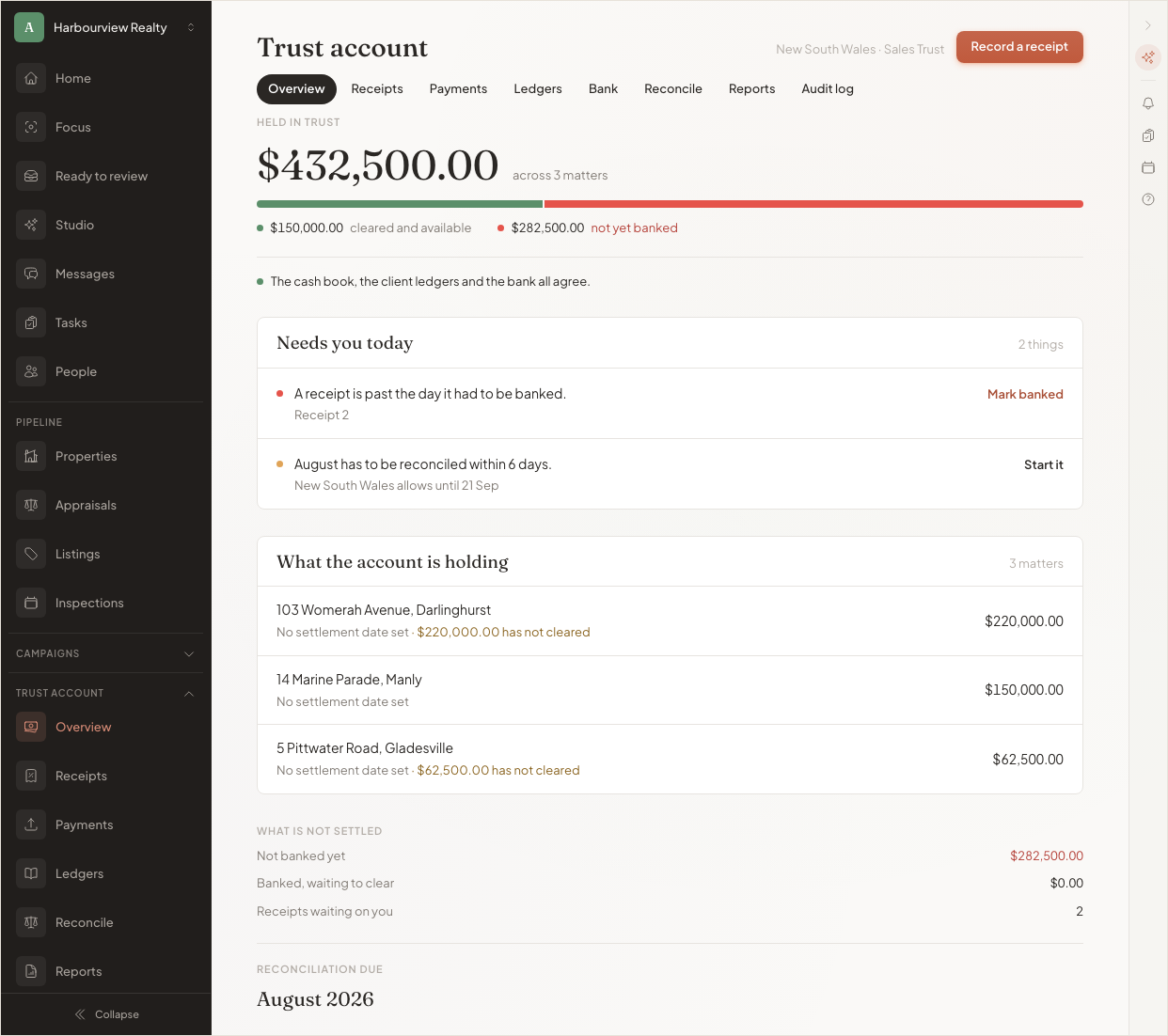
That first screen is what I would want in front of me on a Monday. How much is held, how much of it has not actually reached the bank, whose matters it belongs to, and the two or three things that turn into a problem if today gets away from you.
Receipts
You pick the matter, say who handed the money over and who it is for, and the receipt takes the next number in the book. The numbering never skips. The number is issued once under a lock, rather than typed into a row somebody can quietly delete later.
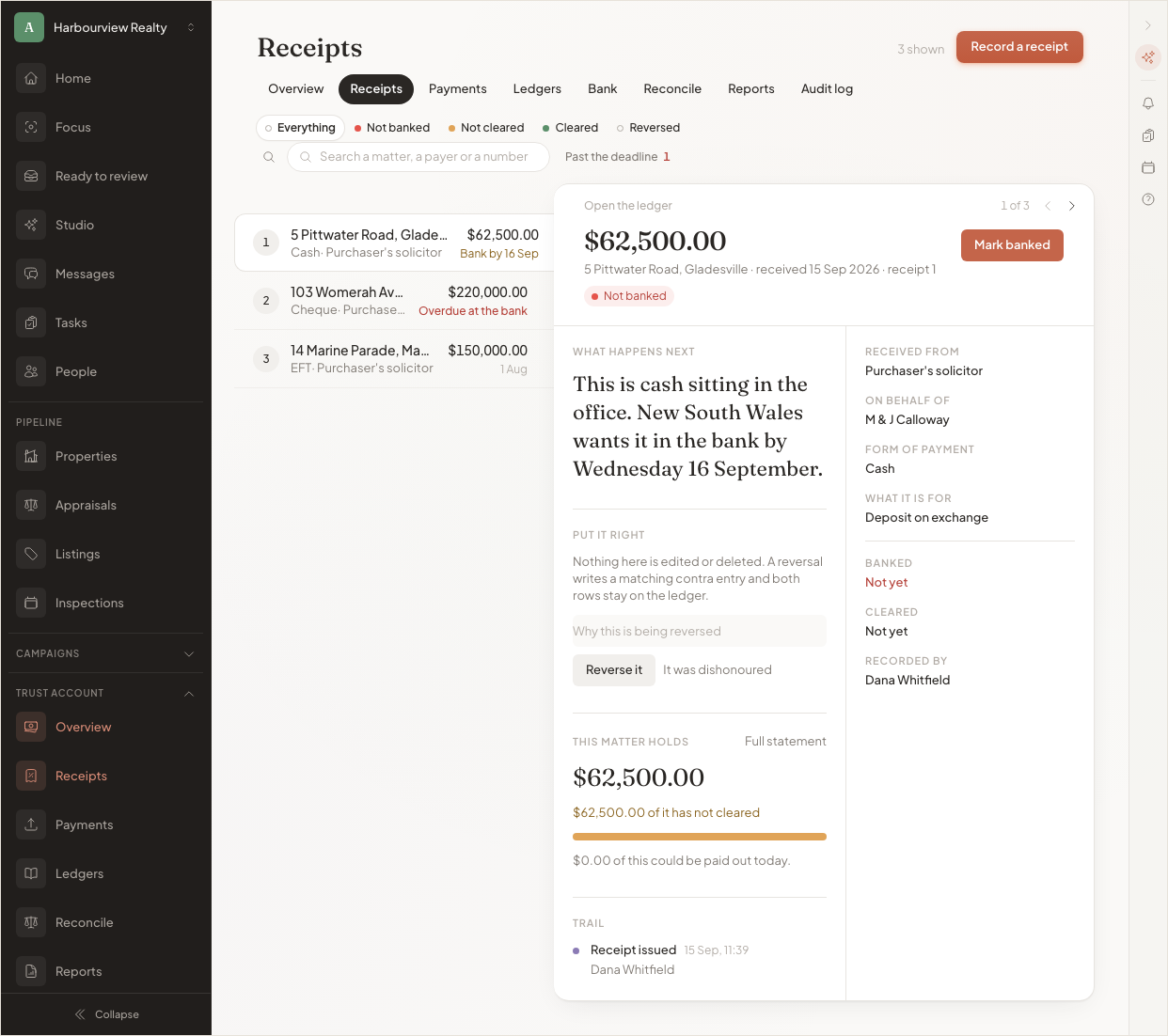
The receipt then tells you in plain words what happens next. Cash taken today in New South Wales has to be banked by the next banking day, so the page says exactly that, with the date on it. Miss the date and the receipt shows up on the overview in red.
Nothing here can be edited or deleted. Sounds annoying. It is the entire point. If a receipt was wrong, or a cheque bounced, you reverse it: the original row stays, a matching row goes in beside it, and both sit on the ledger with your name and your reason attached. That refusal is enforced by the database itself, not by our screens being polite about it.
Two other things it will flatly refuse. You cannot overdraw a matter, and you cannot pay out money that has not cleared yet. Different mistakes, different warnings, both much better caught by us than by a vendor.
The bank statement
Export a CSV from your bank and drop it in. There are presets for CBA, NAB, ANZ, Westpac and Macquarie, plus a generic one for everyone else.
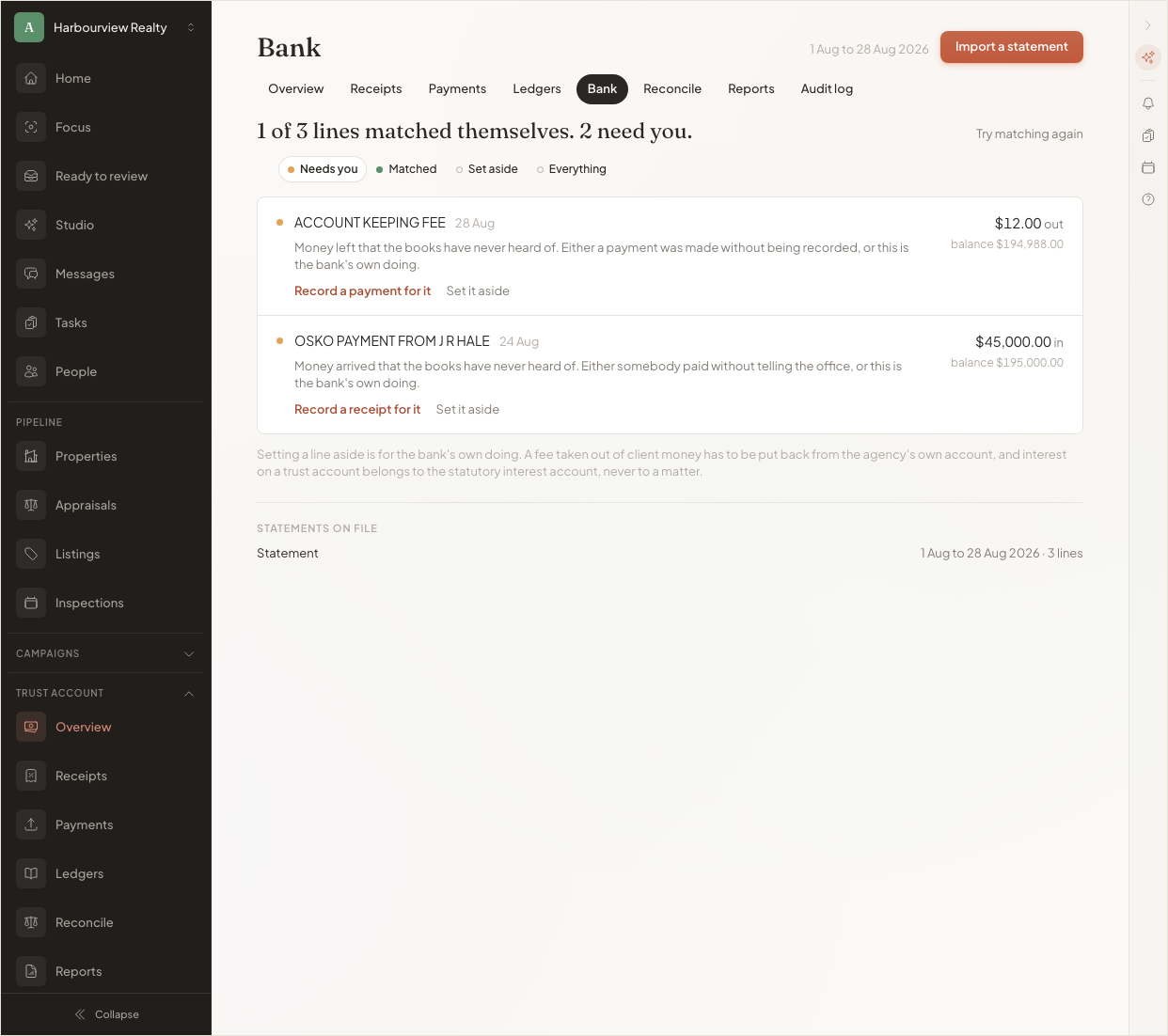
Matching is deliberately timid. Where a line obviously belongs to a receipt you already recorded, it matches itself and clears that receipt at the same time. Anything less than obvious waits for you.
Setting a line aside is doing more work than it looks. A bank fee taken out of client money has to be put back from the agency's own account. Interest on a trust account belongs to the statutory interest account, never to a vendor. The page says so right where you are standing, instead of assuming the newest person in the office already knows.
Reconciliation
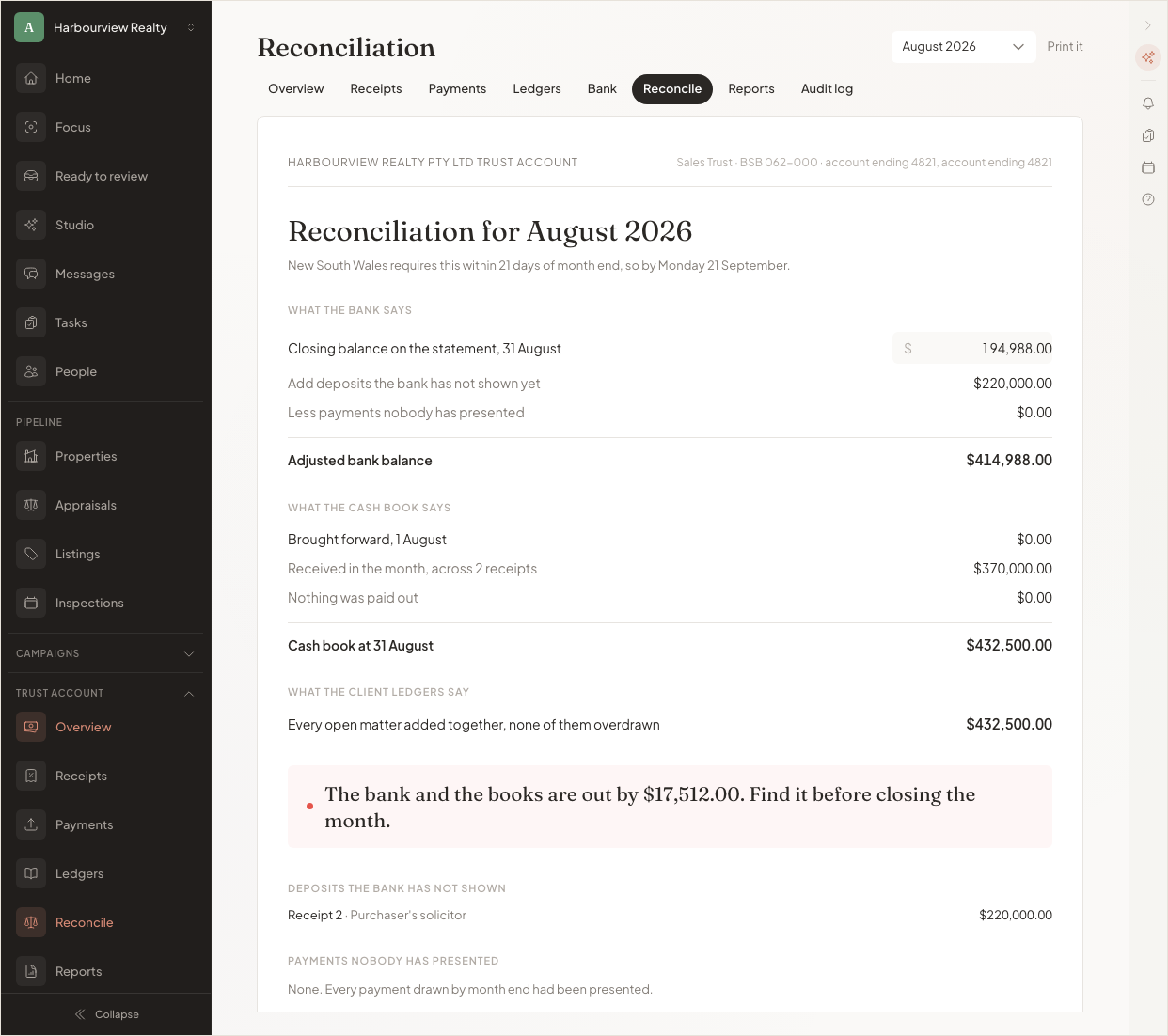
Every trust package produces a reconciliation. Most of them produce it in accountant. Ours is written the way you would say it out loud: this is what the bank says, this is what the cash book says, this is what all the client ledgers add up to, and this is the gap.
There are two kinds of gap and they are not the same animal.
Bank against cash book is ordinary timing. A cheque has not gone through yet. Fine.
Cash book against the client ledgers should be zero every single time. If it is not, your books disagree with themselves, and that is the one worth stopping your morning for.
When the month is done, you close it. Nothing can be posted back into a closed month, months have to close in order, and a month will refuse to close while a statement line is still sitting there undecided, even when the totals happen to agree. That last rule irritated me while I was building it. I kept it anyway.
Settlement
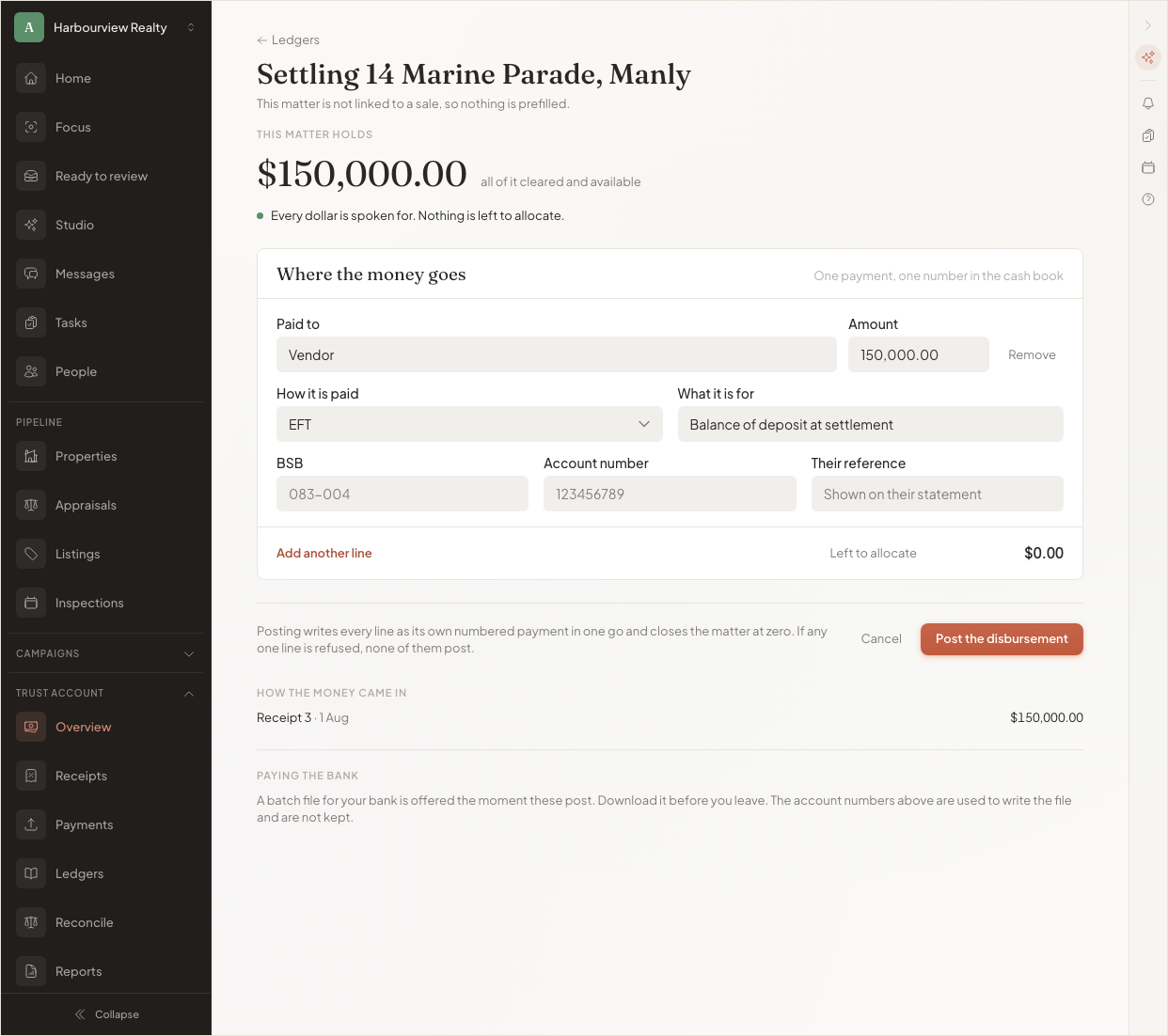
Settlement is one pot going several directions at once. Commission, advertising, whatever is left to the vendor. The screen makes you account for every dollar and will not post until the amount left to allocate reads zero.
Then the lines post together, each as its own numbered payment, and the matter closes at nil. If one line is refused, none of them go in. There is no half settled.
Paying the money out is where we stop. Ociate writes an ABA batch file and you upload it at your own bank. We are not planning to replace that with a payment API, now or later. Trust money should leave a trust account through a person authorised on that account, and that person is you with your bank login, not our server. I would rather this step stayed slightly manual.
The audit pack
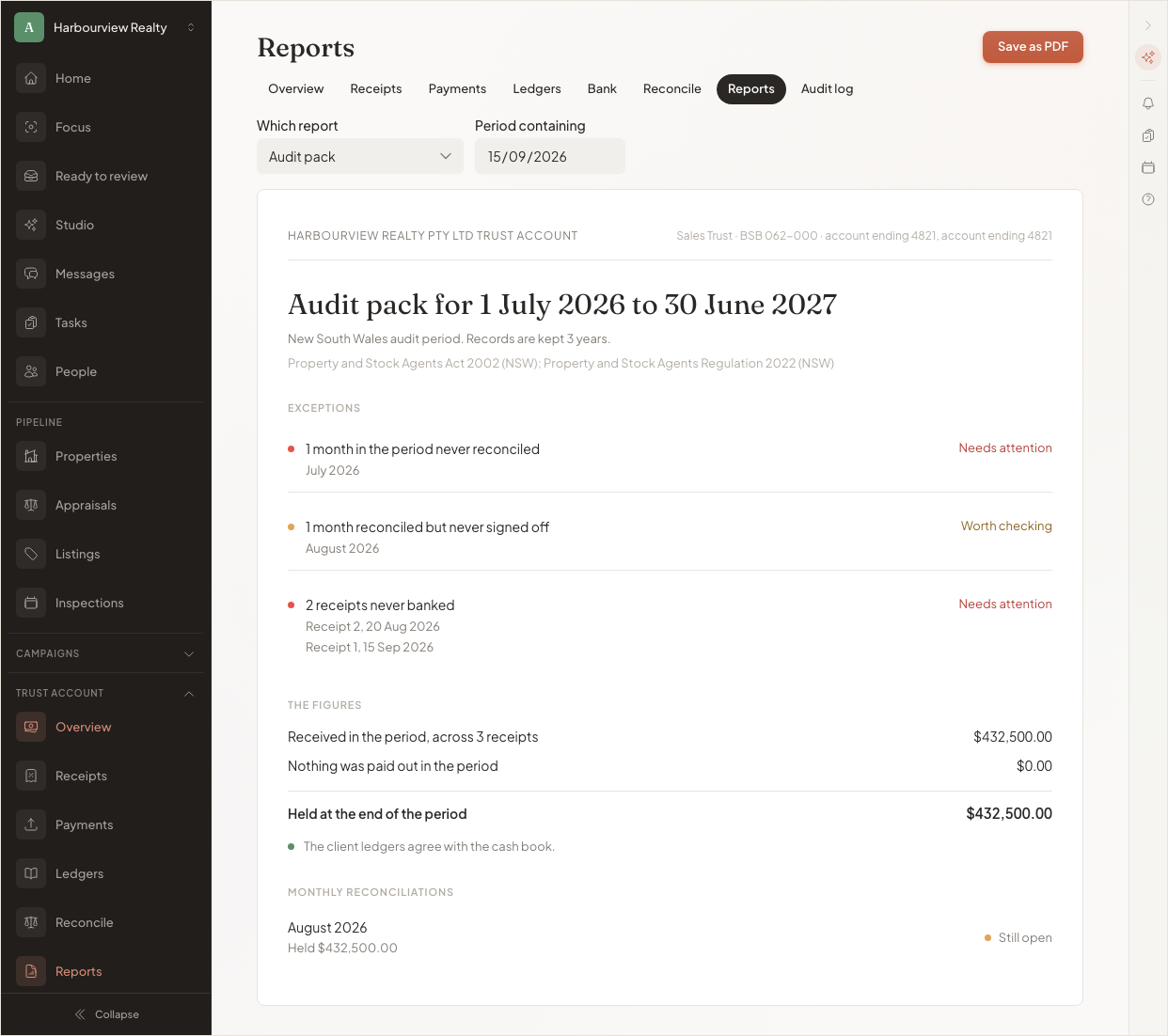
The report you would hand an auditor is a button. So are the cash book and the trial balance, for whatever period you ask for. Each one files itself into your documents as it prints, so it is still sitting there in two years when somebody comes asking.
The useful part is the exceptions list at the top. A month in the period nobody ever reconciled. A month reconciled but never signed off. Receipts that never made it to the bank.
None of those announce themselves at the time. That is the whole reason they are on the front page of the pack, and why it is better to read that list yourself in March than have it read to you in July.
Where the edges are
Worth knowing what you are getting before you move your books into it.
It covers sales trust, so deposits held between exchange and settlement. Rent and bonds sit under a separate set of regulations with their own reporting, and we would rather do that properly later than half do it now.
Bank statements come in as files you import rather than a live feed. That is one extra step each month, and we know it. A feed is very doable, and it is near the front of the queue the moment an office using this in anger wants one.
PEXA sits alongside this rather than inside it. The deposit you hold is not part of the settlement workspace, and the thing that releases it is the authority from the vendor's solicitor, which is a document and a decision more than it is an integration.
And it will not do your audit for you. What it does is hand your auditor a clean set of books and a much shorter list of questions, which in our experience is most of the pain anyway.
Which states, and what to check
New South Wales, Victoria and Queensland, each with its own deadlines and its own receipt wording. Records are kept for three years in NSW, five in Queensland and seven in Victoria. Queensland also wants the monthly reconciliation within five business days of month end, which is far tighter than the other two, so a Brisbane office gets nagged earlier.
Two honest caveats before you lean on any date we put on a screen.
Business day maths counts weekends but not public holidays yet, so a deadline sitting next to Australia Day is a day optimistic.
And Queensland audit periods run from the anniversary of your licence rather than the financial year. Until you tell us your licence date, that report falls back to the financial year, which is close to right without being your actual date.
All of this came out of the current legislation, but the licence is yours and so is the fine. Check the deadlines against your own regulator before you close your first month in here.
Have a look before you commit
You can open the whole thing with a worked example already sitting in it. A deposit settling next week, a cheque still clearing, a receipt that has already blown its banking deadline, last month reconciled.
None of that is written to your database. It is a demonstration that disappears when you close the tab, because the last thing a real trust ledger should ever contain is fake money that cannot be taken back out again.